Distortion
Module ID fx.distortion · Category Effect
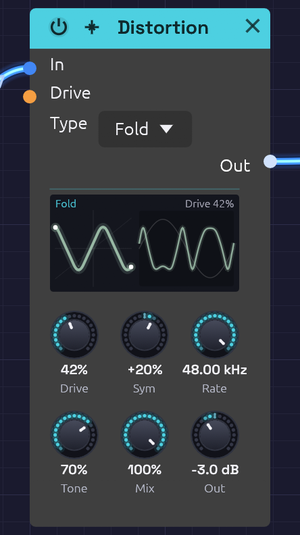 A low sine into the folder: the whole curve lit, and the wave on the right folding back at its peaks
The Distortion adds harmonics by pushing a signal into a curve: rounding it off, clipping it, folding it back on itself, or crushing it into steps. Five types cover everything from a touch of warmth on a bass to a sine folded into a buzzing, vocal tone.
Every curve runs at four times the sample rate with antiderivative anti-aliasing (ADAA). Even full drive on a high note adds only harmonics of that note, not the inharmonic "digital fizz" a naive distortion folds back into the audible range. The dry signal is mixed in at the same oversampled rate and aligned to the sample, so Mix blends cleanly without comb filtering.
The display
The display shows the bend and how far into it the sound goes.
- The curve. On the left, what goes in runs across from −1 to 1, and what comes out runs up. It is the module's own curve for the chosen Type, after Drive (and for Fold, Sym), blended by Mix and scaled by Out. Soft is a gentle S, Hard flattens at the top, Fold zigzags back down, Tube leans, and Bit is a staircase with fewer steps the harder it's driven.
- The lit stretch. The part of the curve the input reaches right now is lit, with a dot at each end, and it glows hotter as Drive rises. Turn up a quiet input and you can watch it walk into the bend.
- The wave. On the right is one cycle of a sine at the input's level, faint, and over it what the curve makes of that sine. That is the shape the new harmonics come from: rounded shoulders for Soft, flat tops for Hard, extra wiggles for Fold.
- Words. The top right gives the drive, in orange while Drive CV moves it. For Bit it gives the bits kept and the crushed rate instead.
Tone isn't drawn: it shapes the sound after the curve.
Inputs
| Port | Signal Type | Description |
|---|---|---|
| In | Audio (Blue) | Signal to distort |
| Drive CV | Control (Orange) | Moves Drive around the knob: ±1 adds ±50% |
Outputs
| Port | Signal Type | Description |
|---|---|---|
| Out | Audio (Blue) | Distorted signal |
Parameters
| Control | Range | Default | Description |
|---|---|---|---|
| Type | Soft / Hard / Fold / Bit / Tube | Soft | Distortion curve (dropdown on the node) |
| Drive | 0 – 100% | 50% | How hard the signal is pushed into the curve |
| Sym (Symmetry) | −100% – +100% | 0% | Fold only: shifts the wave off center before it folds |
| Rate | 100 Hz – 48 kHz | 48 kHz | Bit only: the crushed sample rate. The top of the range is off |
| Tone | 0 – 100% | 50% | Lowpass after the curve, from 200 Hz to 20 kHz |
| Mix | 0 – 100% | 100% | Dry (0%) to distorted (100%) |
| Out (Output) | −12 dB – +12 dB | 0 dB | Level after distortion |
Drive keeps working while Drive CV is patched: the knob sets the center and the CV moves around it.
Types
Soft
Smooth tanh saturation that rounds off peaks. Drive raises the input gain from 1x to 11x. It produces odd harmonics that fall away smoothly, and compresses as it goes: warmth at low drive, fuzz at high drive.
Hard
Clipping that flattens the peaks. Drive lowers the clipping point from full scale to a tenth of it. Bright, buzzy odd harmonics, with a transistor-fuzz edge.
Fold
A wavefolder in the West Coast tradition of the Serge and Buchla folders. Past the clipping point, the wave reflects back toward zero instead of flattening, then reflects again. Drive raises the gain from 1x to 6x, and each step adds another fold and another pair of peaks, up to about three folds per half-wave at full scale. The corners of each fold are rounded, as a real diode folder's are.
A plain sine comes out bright, vocal or metallic, and sweeping Drive with CV gives the classic wavefolder sweep.
Sym shifts the wave off center before it folds. The two halves then fold differently and even harmonics appear. Near ±100%, a quiet sine sits on a fold's peak and comes out an octave up.
Bit
Bit-depth and sample-rate reduction, for lo-fi character.
- Drive lowers the bit depth from 16 bits at 0% to 2 bits at 100%.
- Rate holds each sample for longer, like an old sampler. Below a few kHz, the crushed rate's mirror images ring out as metallic, inharmonic tones; that aliasing is the sound. It depends only on Rate: the engine's own sample rate adds none.
Tube
Asymmetric saturation, like a triode biased off center. Drive raises the input gain from 1x to 11x. The two halves of the wave saturate at different levels, so even harmonics appear from the first touch of drive: warm, thick, slightly hollow. The DC offset this creates is removed automatically.
Tone
Tone is a gentle lowpass on the distorted signal, spaced evenly in octaves from 200 Hz at 0% to 20 kHz at 100%. 50% is about 2 kHz, 65% about 4 kHz, 75% about 6 kHz. Distortion creates a lot of high harmonics, and Tone is the quickest way to take the harshness off them. It affects only the distorted signal, not the dry.
Bypass
Click the power switch in the node header, press Ctrl+B with the module selected, or choose Bypass from its right-click menu. In passes straight to Out. The switch crossfades over 20 ms.
Starting points
| Sound | Type | Drive | Tone | Mix |
|---|---|---|---|---|
| Subtle warmth | Soft | 20% | 100% | 50% |
| Bass grit | Soft | 40% | 50% | 70% |
| Tape-ish thickening | Tube | 25% | 60% | 60% |
| Aggressive lead | Hard | 80% | 65% | 100% |
| Lo-fi sampler | Bit | 50% (Rate 8 kHz) | 100% | 80% |
Distortion raises the level, especially at high drive. Use Out to match the bypassed level before you judge whether it sounds better.
Patch ideas
Wavefolded sine. A sine has nothing for a filter to remove; folding gives it harmonics first:
[Oscillator Out] ──> [Distortion In]      Type Fold, Drive 50%
[Distortion Out] ──> [SVF Filter In]
Octave fold. With Type Fold, Drive 0% and Sym 100%, a sine comes out an octave up.
Envelope-driven drive. More distortion on the attack, cleaner as the note sustains:
[ADSR Out] ──> [Distortion Drive CV]
Before or after the filter. Distortion before the filter gives the filter more harmonics to work on, and the filter tames them. Distortion after the filter adds grit to whatever the filter left, so it changes character as the cutoff moves. Before the VCA, the amount of distortion stays constant; after it, quiet notes stay clean and loud ones break up.
Related modules
- SVF Filter and Ladder Filter: shape the harmonics distortion adds. The Ladder has its own saturating Drive
- Compressor: control dynamics before or after
- EQ: fine-tune the distorted tone
- Tape: saturation with the wobble and dulling of a tape machine, for a whole bus