Oscillator
Module ID osc.sine · Category Source
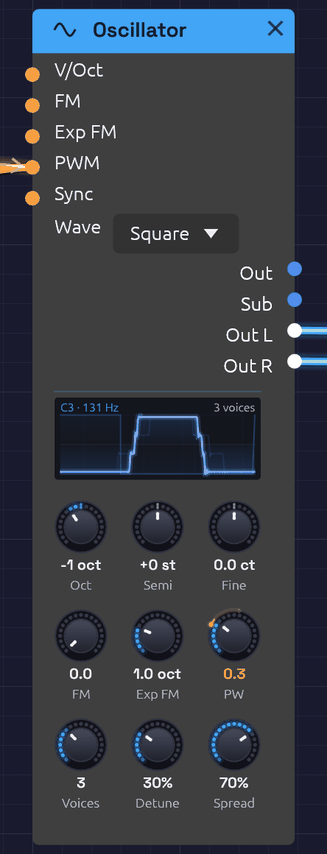 Three detuned voices of a square wave, an LFO sweeping its pulse width through PWM: the trace is Out as it plays, and PW follows the CV. Under it, the tune, timbre and ensemble rows.
The Oscillator is the main sound source in Soba. It is a VCO (voltage-controlled oscillator): a tuned waveform whose pitch follows a keyboard, an LFO or another oscillator.
Beyond the four classic waveforms, it has the features that make an oscillator an instrument:
- a tune section in octaves, semitones and cents;
- hard sync to another oscillator;
- through-zero linear FM and exponential FM;
- a sub-oscillator one octave down;
- unison of up to seven voices, with stereo spread. Seven detuned saws is the classic supersaw.
The display draws a cycle of the wave at the Pulse Width, and reads the pitch the tune section sets. With more than one unison voice, the others are drawn faintly over it, sliding along the cycle at the rate each beats against the pitch: a gentle Detune drifts, a wide one shimmers. With Sub patched, two cycles show, with the sub's square under them.
While the patch plays, what Out really carries is drawn over that shape, lit, and the shape steps back to a faint guide. Each trace starts where the cycle does and keeps the time scale of the cycle the knobs set, so a note V/Oct takes an octave up fits two cycles in, and one an octave down shows half a cycle: a melody squeezes and stretches the wave. PWM sweeps the edge, FM wrinkles the wave, Sync cuts each cycle short, and unison voices beat in it as they sound. Older traces fade behind the newest, like a scope's phosphor, so a moving wave leaves a soft trail. With V/Oct or Exp FM patched, the top reads the note being played. When the sound stops, the shape comes back.
Every waveform is band-limited. Each voice runs at twice the sample rate with polyBLEP corrections on its edges and polyBLAMP corrections on its corners, then a halfband filter brings it back down. A 5 kHz saw's aliasing sits around -80 dB, so high notes and sync sweeps stay clean.
Inputs
| Port | Signal Type | Description |
|---|---|---|
| V/Oct | Control (Orange) | Pitch, 1 per octave. Each +1.0 raises the pitch one octave, on top of the tune section |
| FM | Control (Orange) | Through-zero linear FM, scaled by the FM knob |
| Exp FM | Control (Orange) | Exponential FM, Exp FM knob octaves per unit |
| PWM | Control (Orange) | Pulse-width modulation around the PW knob (±1 moves it ±0.4) |
| Sync | Control (Orange) | Hard sync. Each rising zero crossing restarts the cycle. Accepts audio, control or gates |
Outputs
| Port | Signal Type | Description |
|---|---|---|
| Out | Audio (Blue) | All unison voices, mixed to mono |
| Sub | Audio (Blue) | Square wave one octave below the tuned pitch |
| Out L | Audio (Blue) | Unison voices spread to the left |
| Out R | Audio (Blue) | Unison voices spread to the right |
Parameters
The knobs sit in three rows: tune, timbre and ensemble.
| Control | Range | Default | Description |
|---|---|---|---|
| Oct | -4 to +4 | 0 | Octaves above or below C4. Clicks in whole octaves |
| Semi | -12 to +12 | 0 | Semitones. Clicks in whole semitones |
| Fine | ±100 cents | 0 | Fine tuning |
| FM | 0 – 5 | 0 | Linear FM index (see below) |
| Exp FM | 0 – 4 oct | 1 | Octaves of pitch change per unit at the Exp FM input |
| PW | 0.1 – 0.9 | 0.5 | Pulse width of the square (0.5 is a 50% duty cycle) |
| Voices | 1 – 7 | 1 | Unison voices |
| Detune | 0 – 100% | 40% | How far apart the unison voices are tuned |
| Spread | 0 – 100% | 50% | How wide the unison voices sit across Out L and Out R |
| Wave | Sine / Saw / Square / Tri | Sine | Dropdown on the node |
With every tune knob at 0, the oscillator plays C4 (261.63 Hz). Note In sends 0.0 for C4, so it plays in tune with nothing else to set. MIDI note 69 plays 440 Hz to within a tenth of a cent.
Pitch is smoothed in octaves, not Hz, so a jump of an octave up takes as long as an octave down.
Waveforms
The preview at the top of the node draws one cycle of the selected waveform, and follows the PW knob on the square.
- Sine is a pure tone with no harmonics: sub-bass, FM carriers and modulators, flute-like tones.
- Saw has every harmonic, falling as 1/n: classic leads and basses, strings, brass. It is the richest source for filtering, and the one to use for a supersaw.
- Square has odd harmonics only, for hollow, woody, clarinet-like tones. Pulse width reshapes it, from the square at 0.5 to thin and nasal near 0.1 or 0.9.
- Tri (triangle) has odd harmonics that fall away fast: softer than the square, brighter than the sine.
Tune section
Oct and Semi set the note; Fine trims it in cents. To tune a second oscillator a fifth up, set Semi to +7. To make it beat slowly against the first, add a few cents of Fine.
Hard sync
Patch another oscillator's Out into Sync:
[Osc 2 Out] ──> [Osc 1 Sync]
Every time Osc 2's waveform rises through zero, Osc 1 starts its cycle again. The result repeats at Osc 2's pitch, but its tone comes from Osc 1's pitch. Tune Osc 1 above Osc 2 and sweep its pitch (a slow LFO or envelope on V/Oct or Exp FM) for the classic tearing sync sweep.
The reset itself is band-limited, so sync sweeps don't fizz with aliasing.
Through-zero FM
The FM input multiplies the pitch by 1 + FM × input, where FM is the knob:
- At an FM of 1, an input of -1 just reaches 0 Hz.
- Past 1, the frequency swings through zero and the waveform runs backward for a moment, instead of stalling at 0 Hz.
That keeps the average pitch where it was, so deep FM stays in tune and keeps the bright, glassy character of DX-style FM. Because the depth is relative to the pitch, the timbre stays the same as you play up the keyboard.
[Osc 2 Out] ──> [Osc 1 FM]
[Osc 1 Out] ──> [VCA In] ──> [Audio Output]
- Sine into sine gives the cleanest FM tones.
- Whole-number pitch ratios (Semi +12, or +19 for 3:1) sound harmonic.
- Other ratios sound bell-like and metallic.
- Shape the modulator's level with an envelope (through a VCA) to make the brightness decay like a struck bell.
The FM Synthesis recipe builds a complete patch around this.
Exponential FM
Exp FM works like a second V/Oct input with its own depth knob. An LFO into it gives a vibrato that's even in pitch: the same width in cents on every note. Keep the depth small (Shift-drag the knob for fine steps): 0.02 octaves is about ±24 cents. At audio rates it gives a rougher, less pitch-stable kind of FM than the linear input.
Sub-oscillator
Sub is a square wave one octave below the tuned pitch. It divides the main oscillator's own cycle, so it follows V/Oct, FM and sync. Mix it in under a saw for weight:
[Oscillator Out] ──> [Mix In 1]
[Oscillator Sub] ──> [Mix In 2]
[Mix Out] ──> [Ladder Filter In]
Unison and supersaw
Voices stacks copies of the oscillator, each slightly detuned:
- Detune sets how far apart they are. Its curve is gentle at the bottom: 20% puts the outer voices about ±4 cents apart, 40% about ±16 cents, and 100% a full ±100 cents.
- The voices bunch toward the middle, close to Roland's JP-8000 supersaw. The spacing is deliberately uneven, so the voices never beat in lockstep.
- Each voice starts at a different point in its cycle, so the stack doesn't open with one loud spike.
- Out sums all the voices at about the loudness of one voice.
- Out L and Out R pan the voices across the stereo field, outer voices widest. Spread sets the width.
For a supersaw: Wave on Saw, Voices at 7, Detune about 40%, and Out L and Out R into the output's Left and Right.
Pulse-width modulation
With the square wave selected, modulate the pulse width with an LFO:
[LFO Out] ──> [Oscillator PWM]
Slow rates give a chorus-like shimmer; fast rates, a more dramatic wobble in the tone.
The PW knob stays where you set it, as the centre of the sweep. An orange arc on its rim runs out to a bead at the width the oscillator is playing, and the number under it reads that width in orange.
Patch examples
Sync lead
[Note In Pitch] ──> [Osc 2 V/Oct]
                ──> [Osc 1 V/Oct]   (Osc 1 Oct +1)
[Osc 2 Out] ──> [Osc 1 Sync]
[ADSR Out] ──> [Osc 1 Exp FM]
[Osc 1 Out] ──> [SVF Filter In]
Each note sweeps Osc 1's pitch up with the envelope, while sync holds it to Osc 2's pitch.
Supersaw pad
[Note In Pitch] ──> [Oscillator V/Oct]   (Saw, 7 voices)
[Oscillator Out L] ──> [Reverb In L]
[Oscillator Out R] ──> [Reverb In R]
[Reverb Out L] ──> [Audio Output Left]
[Reverb Out R] ──> [Audio Output Right]
Polyphony
The Oscillator is polyphonic. Patch a polyphonic Pitch cable from Note In into V/Oct and each note gets its own oscillator, with its own phase, sync and unison stack. The knobs are shared by every voice. Unison multiplies the cost: eight notes of a seven-voice supersaw is 56 oscillators. See Polyphony.
Notes
- Older patches load at the same pitch. Their Frequency setting is split into Oct, Semi and Fine. FM Depth, which used to be in Hz, becomes the matching index at that pitch. A MIDI controller mapped to Frequency moves to Oct over the same range. The old Frequency input jack is gone; a cable into it is skipped with a load warning.
- Band-limited edges overshoot a little. Saw and square peak at about 1.3 for a few samples after each edge. This is ringing near 24 kHz, which is inaudible, and any filter or the output stage takes it away.
- The tune section reaches from about 7.7 Hz to 8.9 kHz. Use V/Oct or Exp FM to go further.
Related modules
- LFO for vibrato and PWM
- SVF Filter to shape the oscillator's harmonics
- Ladder Filter, the fat, saturating 24 dB alternative
- VCA and ADSR Envelope to turn a tone into notes