Drum
Module ID source.drum · Category Source
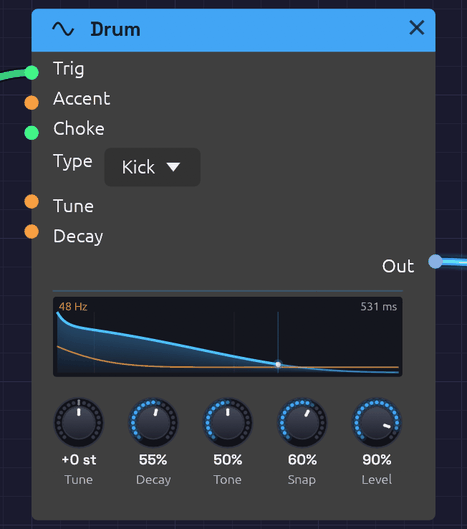 A kick just after a hit. The orange line is its pitch, falling two and a half octaves to 48 Hz in the first few milliseconds. The blue curve is its level, lit up to the playhead.
Drum is one analog drum voice. Its Type turns it into a kick, snare, tom, clap, closed hat, open hat, cymbal, rim, cowbell or shaker, each built the way an 808 or 909 builds that sound: a few oscillators, a noise source, filters and decays. Send it a trigger and it plays one hit.
The same five knobs serve every type, and each means what it would on that drum's own panel. Tune sets the pitch of a kick and the metal of a hat. Snap sets a kick's beater and a snare's wires. The names never change, so a MIDI mapping keeps working when you change the Type.
Drum is polyphonic. A polyphonic gate, from Note In say, plays a new voice for each note, so fast hits ring on over each other instead of cutting each other off.
The types
Each type has its own pitch, its own range of decay, and its own meaning for Tone and Snap. The times are how long a hit takes to fall 60 dB, from Decay at 0 to Decay at 100%.
| Type | Built from | Tune 0 | Decay | Tone | Snap |
|---|---|---|---|---|---|
| Kick | A sine that falls in pitch, and a beater click | 48 Hz | 0.12 – 2.5 s | Drive, from a pure sine to a rounded, 909-like thump | How far the pitch falls (half an octave to four) and how hard the beater clicks |
| Snare | Two drumhead tones, and noise for the wires | 185 Hz | 0.08 – 0.8 s | The wires, from dull to bright | Wires against the drum: more rattle, less tone |
| Tom | A sine that falls half an octave, and a stick click | 110 Hz | 0.12 – 1.8 s | Drive | The stick on the head |
| Clap | Four bursts of noise a few milliseconds apart, then a tail | 1150 Hz band | Tail 0.08 – 1.0 s | Narrow and dark to wide and bright | The bursts against the tail |
| Closed Hat | Six square waves at the 808's inharmonic ratios, ringing in a band around 6 kHz, with hiss above it | 205 – 800 Hz squares | 25 – 300 ms | Where the band sits, and how much air is over it | Hiss against metal |
| Open Hat | The same | The same | 0.15 – 1.8 s | The same | The same |
| Cymbal | The same squares through a low and a high band, a bright splash over a long wash | The same | 0.6 – 5 s | From the low band to the high | Sizzle against metal |
| Rim | Two tones, 1667 and 455 Hz, and a crack of noise | 1667 Hz | 15 – 200 ms | Drive | The crack |
| Cowbell | Two squares a sixth apart, through a bandpass | 540 and 800 Hz | 0.1 – 1.2 s | The bandpass, dark to bright | The clank of the strike over the ring |
| Shaker | A band of noise that swells in over 3 ms, as the beads arrive, rather than striking | 6.7 kHz band | 40 – 200 ms | Where the band sits, from 5 to 9 kHz | The rattle: the beads landing unevenly inside each grain |
The hats' six squares run all the time, as the 808's do. They are never caught at the same place twice, so no two hits sound exactly alike.
Every other type starts at full level the instant it's struck. The Shaker's grain swells in, because the beads in a shaker don't all hit the wall at once. Accent shapes that as a wrist does: a full shake swells in over 3 ms, and a soft one over as much as 8 ms, as well as being quieter and darker.
Inputs
| Port | Signal Type | Description |
|---|---|---|
| Trig | Gate (Green) | A rising edge strikes the drum. Patch a sequencer's Gate, a clock, or a MIDI gate |
| Accent | Control (Orange) | How hard each hit is, from 0 to 1, read as the hit lands. Patch a sequencer's Velocity. Unpatched, every hit is full |
| Choke | Gate (Green) | A rising edge damps the drum within 5 ms. A choke that arrives before a hit does nothing to that hit |
| Tune | Control (Orange) | V/Oct, added to the Tune knob at each hit: 1 V is an octave |
| Decay | Control (Orange) | Added to the Decay knob at each hit |
Outputs
| Port | Signal Type | Description |
|---|---|---|
| Out | Audio (Blue) | The drum. At default settings a full-accent kick peaks around -4 dBFS, and the hats and the rim sit a few dB lower |
Parameters
| Control | Range | Default | Description |
|---|---|---|---|
| Type | Kick … Shaker | Kick | Which drum. The knobs keep their settings when it changes |
| Tune | ±24 st | 0 st | Pitch in semitones from the drum's own |
| Decay | 0 – 100% | 50% | How long it rings, over the type's own range |
| Tone | 0 – 100% | 50% | Dark to bright, as the table describes |
| Snap | 0 – 100% | 50% | The noise or click in the hit, as the table describes |
| Level | 0 – 100% | 80% | Output level |
Tune, Decay, Tone and Snap are read when a hit lands, as on a drum machine. A hit keeps its sound however the knobs move while it rings, and the next hit takes the new settings. Level follows the knob at once.
Accent
Accent scales the hit's level, so at 0.4 it plays 8 to 10 dB quieter, and at 0 not at all. A softer hit is also darker and less snappy, as on a real drum: Tone drops by up to a quarter and Snap by up to half, and a soft kick falls a little less far in pitch. A ghost note on a snare is a different sound from a backbeat, not just a quieter one. While Accent is patched, the Tone and Snap knobs show this. An orange arc on each runs out to a bead at what the Accent makes of it, and the number under the knob reads that value in orange.
Choke
A hi-hat is two drums that can't ring at once: closing the pedal stops the open hat. To do this, patch the closed hat's trigger into the open hat's Choke as well as its Trig:
[Closed lane Gate] ──> [Drum (Closed Hat) Trig]
                  └──> [Drum (Open Hat) Choke]
[Open lane Gate]   ──> [Drum (Open Hat) Trig]
The open hat rings until the next closed hat lands, then dies in a few milliseconds, the way a drummer's foot shuts it. Any gate can choke any drum: a kick that chokes a long cymbal makes a cut-off crash.
A voice struck again while it's still ringing starts the new hit at once. It lets go of the old one over a millisecond or two, so a fast roll on a long kick doesn't click.
The display
The display draws the hit the knobs will play next. The blue curve is its level. Time runs on a warped axis that is wide at the start, so a kick's 10 ms drop and a cymbal's five-second wash both fit, with faint marks at 10 ms, 100 ms and each second. The ring time is at the top right.
The orange line is pitch. For a kick, snare, tom or rim it is the fall from the strike to the drum's resting pitch, which is printed at the top left. For the hats, cymbal and cowbell it is one line per square wave, each fading as the ring dies. For a clap or a shaker it marks the band the noise rings in, and the shaker's level curve rises from nothing as its grain swells in.
When the drum is hit, the fill flashes, and a playhead travels along the curve, lighting it as it goes. The lit curve is as tall as the hit's Accent, so ghost notes and backbeats read at a glance. A choked hit drops to nothing where the choke caught it. Hover the display for the numbers.
Patches
A kit in a few modules
The Drum Machine example is a whole kit in 14 modules: a Clock, five sequencer lanes, five Drums, a Mixer, a Reverb and the Output. Each sequencer's Gate goes to its Drum's Trig and its Velocity to Accent.
Tuned toms, or a cowbell melody
[Sequencer Pitch]    ──> [Drum (Tom) Tune]
[Sequencer Gate]     ──> [Drum (Tom) Trig]
[Sequencer Velocity] ──> [Drum (Tom) Accent]
Each step's note sets the tom's pitch, with middle C at the Tune knob's pitch. Set the Type to Cowbell for the classic 808 cowbell line, or to Kick with a long Decay for an 808 bass.
A layered snare
Patch one sequencer's Gate into two Drums, a Snare and a Clap, and mix them. The clap's bursts sit on top of the snare's crack. Turn the clap's Snap down so only its tail comes through, as a short room.
Rolls and flams
From a Note In module with several voices, two notes very close together each get a voice, so a flam rings as two hits rather than one cut short. A Clock at 1/16 with a high Swing into Trig makes a shuffled roll. Patch a falling envelope into Decay and the roll tightens as it goes.
Related modules
- Trigger Sequencer: a whole kit's hits from one module, a lane per Drum, with velocity for Accent
- Step Sequencer: one lane of hits, with velocity for Accent and pitch for Tune
- Clock and Clock Divider: the pulses that play it
- Noise and Oscillator: build your own drum from parts, as the Backbeat example does
- Mixer: pans each drum to its place and shares a reverb among them