Tape
Module ID fx.tape · Category Effect
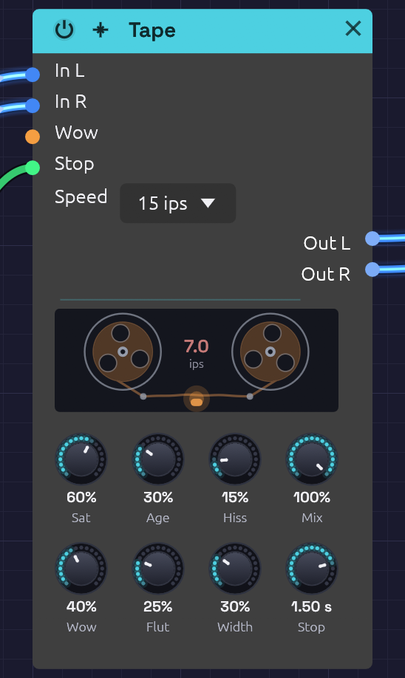 The reels turn at the tape speed and lurch with the wow, dragging as the pitch sags and hurrying as it rises; the head glows as Saturation drives it. When the Stop gate brakes the tape, the reels slow to a halt and the speed between them counts down
The Tape module is a tape machine for a bus. Much of what makes vintage-flavoured music sound warm happens on tape, after the instruments: the record head's soft squash, the head bump in the low end, the slow sway and fast shiver of the transport, the top end the tape can't hold, and, on an old reel, dropouts and hiss. Put it on a mix bus or in front of the Audio Output to give the whole patch that sound.
It shares its transport and record head with the Stereo Delay's Tape mode, which puts the same machine on the echoes only.
How it works
Each channel is recorded onto tape, then played back:
- Record. Pre-emphasis lifts the treble, the drive pushes the signal into the record head, and de-emphasis takes the treble back down, so the highs squash first, as they do on tape. The head bump and the speed's top end follow. Saturation sets the drive.
- Transport. The play head reads the tape a moment behind the record head, and that moment keeps changing with the wow and flutter, which bends the pitch. The right track sways a little differently from the left, by Width.
- Playback. Hiss is added, then the tape's Age: gap loss rolls off the top, and dropouts dip the sound where the oxide has worn away.
A Stop gate brakes the whole machine to a halt, and winds it back up when it's let go: see Tape stop.
With every knob at zero, Tape passes its input through bit for bit. It adds no latency: at rest the play head reads exactly what was just recorded, and the wobble only ever pulls it back in time, never ahead.
Inputs
| Port | Signal Type | Description |
|---|---|---|
| In L | Audio (Blue) | Left of the bus |
| In R | Audio (Blue) | Right of the bus. When unpatched, it copies In L |
| Wow | Control (Orange) | Adds to Wow: +1 adds 100%. The knob stays live and sets the center the CV works around |
| Stop | Gate (Green) | While high, the tape brakes to a halt over the Stop Time; let go, it winds back up. See Tape stop |
Outputs
| Port | Signal Type | Description |
|---|---|---|
| Out L | Audio (Blue) | Left, off tape |
| Out R | Audio (Blue) | Right, off tape |
Parameters
| Control | Range | Default | Description |
|---|---|---|---|
| Sat (Saturation) | 0 – 100% | 30% | Drive into the record head, up to +18 dB, with the head bump |
| Age | 0 – 100% | 15% | From new to found in an attic: duller, with dropouts and a little hiss |
| Hiss | 0 – 100% | 15% | Tape hiss, up to −34 dBFS |
| Mix | 0 – 100% | 100% | Dry (0%) to tape only (100%) |
| Wow | 0 – 100% | 25% | The slow sway of the reels: up to ±40 cents at 15 ips |
| Flut (Flutter) | 0 – 100% | 20% | The fast shiver of the capstan: up to ±12 cents at 15 ips |
| Width | 0 – 100% | 30% | How differently the right track sways from the left |
| Stop (Stop Time) | 50 ms – 4 s | 1 s | How long the Stop gate takes to bring the tape to a halt. Winding back up takes half as long |
| Speed | 7½, 15, 30 ips | 15 ips | Tape speed (dropdown on the node) |
Speed
Slower tape sways further and more slowly, holds less top end, and bumps lower:
| Speed | Wow and flutter | Head bump | Top end | Full Age leaves | Emphasis |
|---|---|---|---|---|---|
| 7½ ips | 1.6× deeper, half as fast | 40 Hz | 12 kHz | 3.5 kHz | NAB, 50 µs |
| 15 ips | as the knobs say | 70 Hz | 18 kHz | 5.5 kHz | IEC, 35 µs |
| 30 ips | 0.6× as deep, twice as fast | 120 Hz | 22 kHz | 8 kHz | AES, 17.5 µs |
Changing speed glides: the play head eases to its new sway rather than jumping, like a motor finding its speed.
Shaping the sound
Saturation. Turning Saturation up puts the signal on tape: the head bump and the speed's top end come in over the first tenth of the knob, and the drive rises from there. Tape is calibrated to the studio convention, where a sine at −18 dBFS RMS sits at 0 VU and keeps its level at any drive. Quieter material comes up a little, louder material is squashed, and the louder it is the more it's squashed, with the treble first. On a full mix that sounds like glue at 20–40%, and like a cassette deck pushed into the red past 70%.
Wow and Flutter. Both knobs work on a square law, so the bottom of each is fine and the top is extreme. The pitch swings by:
| Knob | Wow at 15 ips | Flutter at 15 ips |
|---|---|---|
| 25% | ±2.5 cents | ±0.75 cents |
| 50% | ±10 cents | ±3 cents |
| 75% | ±22.5 cents | ±6.75 cents |
| 100% | ±40 cents | ±12 cents |
Multiply by 1.6 at 7½ ips and by 0.6 at 30. A couple of cents of wow is felt more than heard; ten is a gentle seasickness; forty is a warped record. Wow is two slow sways at unrelated rates, so it never quite repeats.
Turning Wow up quickly pulls the play head back and sags the pitch for a moment, as a dragging reel would. The depth glides over about a third of a second to keep that brief.
Width. A mono source comes out mono at Width 0, and sways apart into stereo as Width rises. Hiss is always independent between the two sides.
Age. Age rolls off the top, from nothing at 0 to the speed's worn cutoff at 100%. Dropouts start to appear around 30%. At 100% there are about two every three seconds, each 15–150 ms long, dipping the highs more than the lows. Age also adds a little hiss of its own, up to −48 dBFS.
Hiss. Mostly treble, as tape hiss is, and it runs through the Age stage: an old tape hisses darker, and the hiss drops out with the music.
Mix. Below 100%, the wobbling tape copy is blended with the dry signal, which beats against it like a chorus. With Saturation and Age at 0 that's all you hear: a slow, natural tape chorus. A 50% blend sounds about 3 dB quieter than either side alone, because the two copies drift apart.
Tape stop
Press stop on a tape machine, or a turntable, in the middle of a song and everything on it slows down together, so the whole mix falls in pitch to nothing. Patch a gate into Stop and the Tape does the same to its bus.
Braking. While the gate is high, the tape slows at a steady rate and comes to a halt after the Stop Time. The pitch falls in a straight line: a 1 kHz tone with a 1 s Stop Time is at 750 Hz a quarter of a second in, 500 Hz at half a second, and nothing at one second. Below about an eighth of full speed the sound has sunk below hearing, and it fades out there, so a stopped tape is silent rather than holding a frozen sample. Hiss stops with it.
Winding up. Let go of the gate and the tape winds back up in half the Stop Time. Rather than picking up the old tape from where it stopped, which would leave the whole mix late, it picks up what's playing now and runs a little fast to catch up: the pitch climbs from nothing, overshoots by up to a major third, and settles exactly in time. Once it has, the output is the same as if the tape had never stopped, sample for sample, so a song on a clock comes back on the beat. Let go before the tape has stopped and it winds up from the speed it had reached, with the sound it was making fading out over 30 ms beneath it.
Free when idle. With the gate low the stop adds nothing to the sound and no latency.
Stop works on the tape side of Mix: at 100% the whole bus stops, and below that the dry signal plays on through it. For a stop on the master, put Tape last and keep Mix at 100%, even if Saturation, Wow and the rest are at zero.
| Stop Time | Sounds like |
|---|---|
| 50–150 ms | A hiccup: the beat catches for a moment |
| 0.3–0.8 s | A DJ hitting stop on the deck |
| 1–2 s | A tape machine's motor winding down |
| 3–4 s | A slow, heavy spin-down, for the very end |
With an Arranger
An Arranger lane's Gate is high while the lane is above zero, so a lane can press Stop for exactly the bars you choose. Label one lane Stop and patch its gate in:
[Arranger Gate 3] ──> [Tape Stop]
At the end of the song. Give the last section a Jump to 100% on the Stop lane (cue 1001000), and set the Stop Time to a bar or so. On the last section's downbeat the whole song winds down to silence. A song that stops (Loop to off) keeps the lane high, so the tape stays stopped. A song that loops needs the first section to Jump the lane back to 0 (cue 1000000), and the next pass winds up on its downbeat.
A brake fill. Jump the Stop lane to 100% on a one-bar Fill section, and back to 0 on the section after it. The tape brakes through the fill, sits stopped, and winds up on the next section's downbeat, back on the beat. With the Stop Time shorter than the bar there's a moment of silence before the drop; at about the bar's length the tape is still sinking when it's let go.
A hiccup on a Hit. A Hit holds the lane's gate high for half a step, so with a Stop Time of 50–150 ms a Hit on a section's cue makes the bus catch on that downbeat and stumble back in time, a hiccup into the new section.
Bypass
Click the power switch in the node header, press Ctrl+B with the module selected, or choose Bypass from its right-click menu. In L passes straight to Out L and In R to Out R (In R still copies In L when unpatched).
Starting points
| Sound | Speed | Sat | Age | Hiss | Wow | Flut | Width | Mix |
|---|---|---|---|---|---|---|---|---|
| Mix-bus glue | 30 | 30% | 0% | 0% | 0% | 5% | 0% | 100% |
| Warm seventies | 15 | 40% | 20% | 10% | 20% | 15% | 30% | 100% |
| Warped cassette | 7½ | 35% | 45% | 25% | 55% | 30% | 40% | 100% |
| Lo-fi house | 7½ | 60% | 50% | 30% | 25% | 20% | 20% | 100% |
| Found in an attic | 7½ | 50% | 100% | 40% | 70% | 50% | 60% | 100% |
| Tape chorus | 15 | 0% | 0% | 0% | 50% | 0% | 100% | 50% |
Each was checked by rendering Afterglow through it: all but the chorus come out within about 1 dB of the dry patch's loudness, with the peaks lower.
Patch ideas
On the master. Put Tape last, in front of the Audio Output:
[Mixer Out L] ──> [Tape In L]
[Mixer Out R] ──> [Tape In R]
[Tape Out L] ──> [Audio Output Left]
[Tape Out R] ──> [Audio Output Right]
Afterglow, Shoreline, Clair de Satellite and From One Sine all end this way. Each recipe says what its tape adds.
A warped moment. Patch an Arranger lane into Wow, with the knob low. Ramp the lane up through a breakdown and back down for the drop, and the whole mix bends out of shape and back. From One Sine ramps it up through its breakdown and jumps it back to 0 on the drop's downbeat.
Breathing tape. A slow LFO, around 0.05 Hz, into Wow with a small depth makes the sway itself come and go.
Spin down the ending. An Arranger lane into Stop, jumping high on the last section, with a 2–4 s Stop Time: the song winds down to nothing instead of fading out. See With an Arranger.
Only the pads. Put Tape between the pad voice and its Mixer channel, so the drums stay steady while the pads drift.
Related modules
- Stereo Delay: the same tape machine, on the echoes only
- Distortion: Tube saturates without the wobble or the dulling
- Audio Output: Character, a fixed soft clip on the master's peaks. See Character or Tape?
- Arranger and LFO: move Wow, and press Stop